
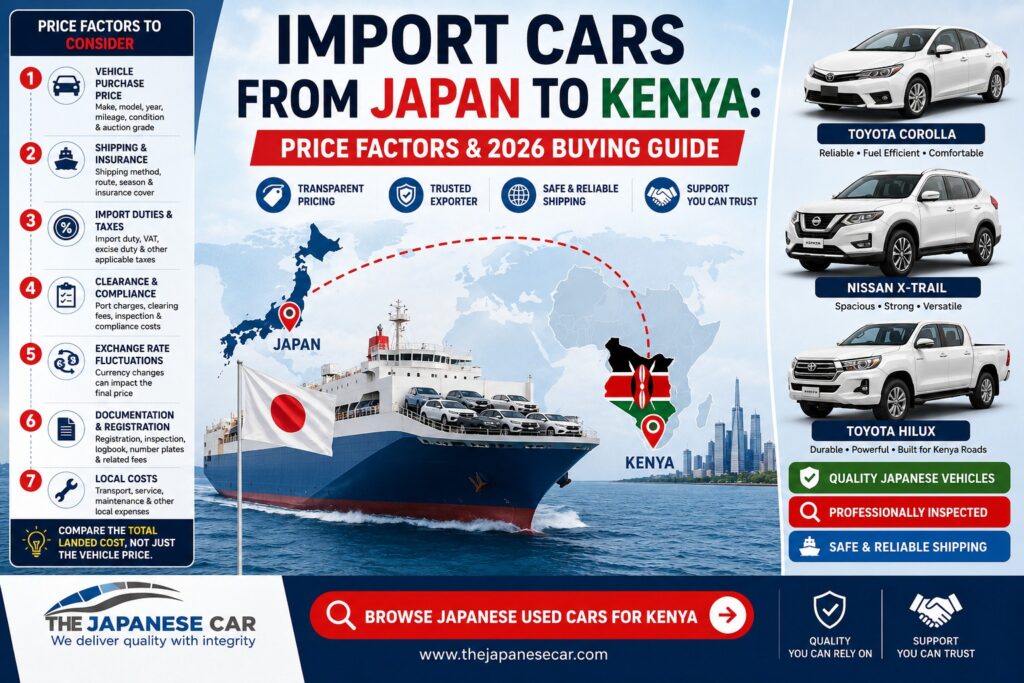
The cost of importing a car from Japan to Kenya depends on the vehicle price, shipping and insurance, applicable import charges, customs and clearance costs, exchange rates, and registration-related expenses. To determine the true price, Kenyan buyers should compare the complete landed cost rather than the Japan-side vehicle price alone.
When buyers search for “import cars from Japan to Kenya price,” they are usually trying to answer one practical question: what will the vehicle really cost by the time it is ready for use in Kenya? The answer is not a single fixed figure. The final amount depends on the vehicle you choose, its condition, shipping and insurance, applicable import charges, local clearance, and other costs connected with getting the car on the road.
For that reason, the best way to compare Japanese used cars for sale in Kenya is to look beyond the advertised vehicle price and understand the full landed-cost picture. A well-planned purchase can help you balance affordability, reliability, fuel economy, and long-term ownership value.
What Determines the Price of Importing a Car from Japan to Kenya?
Vehicle purchase price
Make, model, year, mileage, condition, grade, specifications, and demand all influence the starting price. A clean, well-maintained vehicle may cost more upfront but can reduce the risk of early repairs.
Shipping and insurance
Freight charges vary according to vehicle size, shipping method, route, and timing. Insurance may also form part of the total cost depending on the shipment arrangement.
Import and local clearance costs
Kenyan buyers should budget for the taxes, duties, inspection or compliance steps, port and clearing charges, registration-related costs, and any other requirements that apply at the time of import. Because rules and rates can change, confirm the latest requirements before completing a purchase.
Exchange rates and payment charges
Currency movements can affect the final amount paid in Kenyan shillings. Bank, transfer, or payment-provider charges may also change the total.
Why the Cheapest Listing Is Not Always the Best Deal
A low vehicle price can be attractive, but condition and ownership costs matter just as much. When you buy Japanese used cars in Kenya, compare service history, visible condition, mileage in context, tyre condition, interior wear, accident or repair information where available, and expected parts availability.
The goal is not simply to buy the lowest-priced vehicle. It is to find a car with a sensible total cost and a condition that suits your intended use.
How to Compare Japanese Used Cars for Sale in Kenya
Use the same checklist for every vehicle you shortlist:
- Compare the total estimated landed cost, not only the Japan-side vehicle price.
- Check vehicle condition and available inspection or auction information.
- Choose a model with suitable fuel consumption for your normal driving.
- Consider spare-parts availability and ease of maintenance in Kenya.
- Confirm that the vehicle meets current Kenyan import and compliance requirements before purchase.
- Keep a buffer in the budget for local clearance, registration, servicing, and initial maintenance.
Popular Japanese Cars to Consider for Kenya
Toyota Vitz
A compact choice for city driving, commuting, and buyers focused on fuel economy.
Toyota Probox
A practical option for business users who value cargo space, simple ownership, and everyday utility.
Toyota Corolla / Fielder
Well suited to buyers seeking a comfortable passenger car with broad parts familiarity.
Nissan Note
A compact hatchback that combines useful interior space with economical daily driving.
Mazda Demio
Popular with buyers looking for an efficient, easy-to-drive urban car.
Nissan X-Trail
A versatile SUV choice for families and motorists who need more space and ground clearance.
A Simple Buying Process
A structured process makes the purchase easier and reduces surprises.
- Set a realistic total budget, including purchase, shipping, import, clearance, and initial running costs.
- Shortlist vehicles based on purpose: city use, family use, business, SUV, or commercial needs.
- Review condition, mileage, specifications, photos, and available inspection details.
- Request a clear quotation and confirm what is included and excluded.
- Complete payment and shipping documentation through the agreed process.
- Prepare for clearance and registration in Kenya in line with the current requirements.
Final Thoughts
The search phrase “import cars from Japan to Kenya price” should be approached as a landed-cost question, not just a listing-price question. Compare the vehicle, condition, freight, applicable import charges, local clearance, and expected running costs together.
If you are reviewing Japanese used cars for sale in Kenya, focus on verified vehicle information and a clear cost breakdown. That gives you a better basis for choosing a dependable Japanese vehicle that fits both your budget and your day-to-day needs.
FAQs: Importing Cars from Japan to Kenya
How much does it cost to import a car from Japan to Kenya?
There is no single fixed amount. The final cost depends on the vehicle price, shipping, insurance, applicable import charges, clearance, exchange rates, and registration-related expenses.
Is it cheaper to buy a Japanese used car directly from Japan?
Direct sourcing can provide wider choice and competitive vehicle pricing, but buyers should compare the complete landed cost before deciding.
Which Japanese cars are economical for daily use in Kenya?
Compact models such as the Toyota Vitz, Nissan Note, Mazda Demio, and similar fuel-efficient hatchbacks are commonly considered by cost-conscious buyers.
What should I check before buying a used Japanese car?
Review condition, mileage, available inspection information, specifications, service or auction details where available, and expected maintenance and parts support.
Where can I view Japanese used cars for sale in Kenya?
Explore current Kenya-targeted stock at https://thejapanesecar.com/used-cars-for-sale/kenya/
What determines the price of a Japanese used car imported to Kenya?
The main factors are the vehicle’s purchase price, make, model, year, mileage and condition, plus shipping, insurance, applicable import charges, clearance, exchange rates and registration-related costs.
Is the cheapest Japanese car always the best option?
No. Buyers should consider vehicle condition, mileage, service history, parts availability and expected ownership costs alongside the purchase price.