
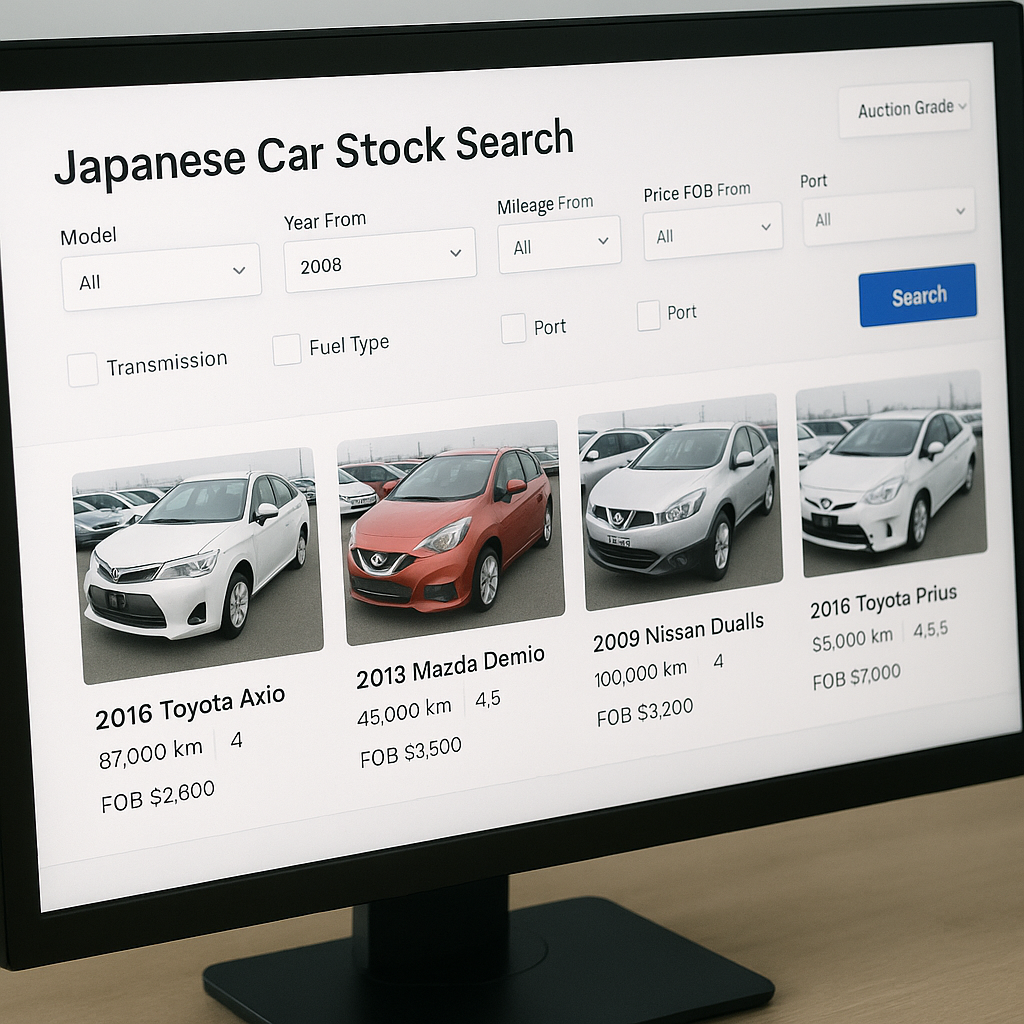
Your complete guide to finding the best Japanese used cars online—faster, easier, and with better accuracy.
Searching for Japanese used cars online can feel overwhelming—too many models, mixed pricing, auction codes, inspection sheets, and hundreds of daily listings.
This guide makes it simple. Whether you’re a first-time buyer or a dealer searching for bulk units, here’s how to search Japanese car stock online quickly and accurately, using filters, grading systems, and price tools the right way.
Start browsing instantly: Japanese Used Cars for Sale → https://thejapanesecar.com/stock-search/
1. Why Online Stock Search Matters When Buying from Japan
Unlike local used-car markets, Japanese stock listings include:
- Auction grades (objective condition marks)
- Detailed inspection sheets
- Service history & odometer verification
- Multiple photo angles
- Real-time availability
This means you can compare condition + price + mileage at a glance and avoid hidden surprises.
2. Understanding the Japanese Car Stock Search System
Most Japanese exporters—especially The Japanese Car—use structured stock pages so buyers can filter quickly.
Common Elements on a Stock Page
- Car name & year
- Mileage
- Chassis code
- Condition grade (Auction Grade)
- Price (FOB)
- Photo gallery
- Engine size & drivetrain
- Availability (In Stock / At Auction)
3. Using Filters (The Most Important Step)
Filters help you narrow thousands of units down to exactly what you want.
Key Filters You Should Always Use
1. Make & Model
Toyota, Nissan, Mazda, Honda, Subaru, etc.
Examples:
- “Toyota Corolla Axio 2015–2019”
- “Honda Fit Hybrid 2017+”
2. Year Range
Japan’s strict Shaken tests ensure newer cars are well-maintained.
Filtering by year eliminates irrelevant vehicles and saves money.
3. Mileage
Below 90,000 km is ideal for most imports.
For hybrids, aim for below 120,000 km.
4. Price Range (FOB)
Set realistic FOB budgets.
Example:
- Prius 2012 often lands between ¥450,000–¥850,000 FOB
- Toyota Vitz 2017 can be ¥350,000–¥600,000 FOB
5. Body Type
Sedan, hatchback, SUV, hybrid, kei car, wagon, van, pickup.
If you’re undecided, compare 2–3 types side-by-side.
6. Transmission & Fuel Type
- AT / MT
- Hybrid / Petrol / Diesel
7. Stock vs Auction
- Stock cars → instantly available, fixed price
- Auction units → requires bidding but often cheaper
4. Understanding Japanese Auction Grades
One of the biggest advantages of buying Japanese used cars is the objective grading system.
Overall Body Grades
| Grade | Meaning |
| 5 / 4.5 | Like-new condition, rare |
| 4 | Very clean, minor wear |
| 3.5 | Good condition, normal wear |
| 3 | Fair condition, may need repairs |
| R / RA | Repaired history |
| A / 0 | Accident-grade, not recommended |
Interior Grades
- A = Excellent
- B = Clean
- C = Normal
- D = Needs cleaning/repair
Tip: Grades 3.5/B or better are safest for budget buyers.
5. How to Compare Pricing (FOB, CNF, CIF)
Price differences can be confusing—here’s the quickest breakdown:
FOB (Free On Board)
Covers: vehicle + Japan-side handling.
Does NOT include freight or insurance.
CNF/CFR (Cost + Freight)
Covers: FOB + shipping to your port.
CIF (Cost + Insurance + Freight)
Includes marine insurance.
Quick Formula:
Final Landed Cost = Car Price + Freight + Insurance + Duties + Port Fees + Compliance Cost
Use our advisors if you need exact cost-to-country quotes.
6. How to Read Japanese Stock Photos Correctly
Dealers in Japan upload photos that reveal real conditions if you know what to look for.
Check these carefully:
- Steering wheel wear
- Door step scratches
- Boot/floor condition
- Engine bay cleanliness
- Undercarriage rust (important for UK/Kenya buyers)
- Panel gaps (possible accident repair)
Pro tip: If the auction sheet shows “A1, U1, W1” → minor marks
If you see “XX or XXX” → replaced panel
7. Stock vs Auction: Which Should You Choose?
Choose Stock If:
✔ You want fast shipping
✔ You prefer fixed pricing
✔ You need vehicles for your dealership
Choose Auction If:
✔ You want the lowest possible price
✔ You need more selection
✔ You want rare trims (Fielder Hybrid, Axio Hybrid G, Vellfire ZG, etc.)
8. How to Avoid Overpaying (Pricing Tips)
- Compare at least 5–10 units of the same model/year
- Check mileage variations
- Avoid grade “R” unless price is compelling
- Filter by month/year (Japan releases many variants each year)
- Look for fresh listings updated daily
Frequently Asked Questions
Q1: How accurate are Japanese auction grades?
Extremely accurate—auctions penalize sellers heavily for misreporting.
Q2: Can I buy without seeing the car in person?
Yes. The Japanese Car provides detailed photos + auction sheet + verification.
Q3: Why do prices vary so much between similar models?
Mileage, grade, condition, color, location, and auction popularity all matter.
Q4: How do I get shipping costs to my country?
Send us the car link + destination port → we calculate instantly.